Do interior design and acoustic insulation work well together?
I would say yes without hesitation, but in this article, no interior design per se. Although some sound insulation can be very design-oriented, this will be the subject of an upcoming article on "interior design and design insulation products".
In this post, we will discuss various solutions in order to have several good ideas of techniques to implement to be quiet at home.
The acoustic insulation can be made of different materials, wood chipboard, synthetic material, cork, mineral fibre etc. You will have to choose according to your ideologies and your budget.
Noise pollution or acoustic disturbance can be caused by several factors outside the building (planes, trucks, cars, shrapnel) or inside the building (neighbors, plumbing). In addition, the noise pollution or acoustic disturbance can be airborne (music, planes, televisions) or impact-based (shoes, musical basses, chairs).
There is a solution to every problem. Before I give you a few, let’s take a closer look at what sound is. The unit of measure is the decibel, the particularity of the decibels is that this measure is not cumulative. A picture is worth a thousand words.
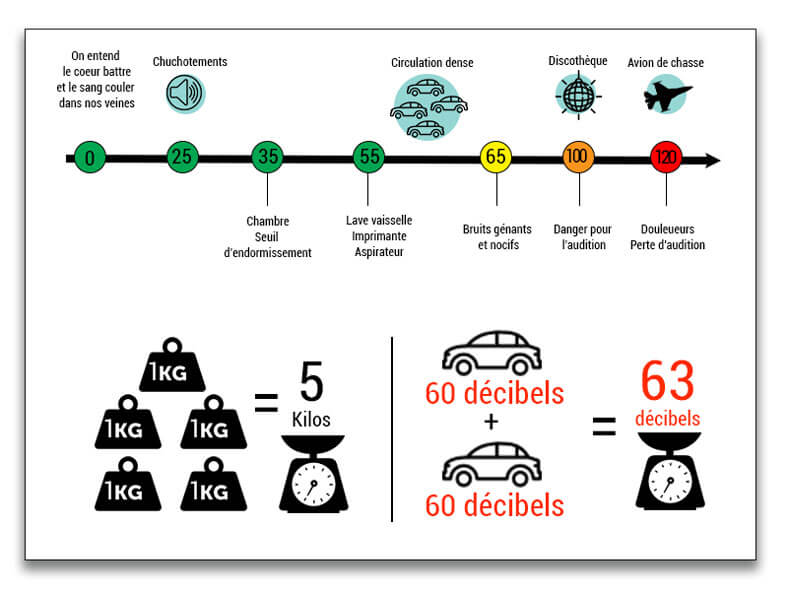
The decibels
Noise pollution can be tackled by several means, and the solutions usually have to be combined to obtain a satisfactory result.
This depends on the materials used to build your condo or collective dwelling. The same acoustic or sound insulation techniques will not be used if the construction is made of concrete or if it is mostly made of wood. Keep in mind that the heavier the insulating material, the more it insulates, the more the mass law.
Acoustic insulation of the ceiling:
The best solution is to treat the problem at the source; soil insulation is therefore preferred.
If this is not possible, the installation of plasterboard on a metal or wood frame is very effective if you add insulation between the upper floor and the ceiling. For increased efficiency, there are anti-vibration hangers that do not transmit shocks to plasterboard ceilings. There are also long-span frames that attach from wall to wall; in this case, the ceiling does not transmit the vibrations of the upper floor at all.
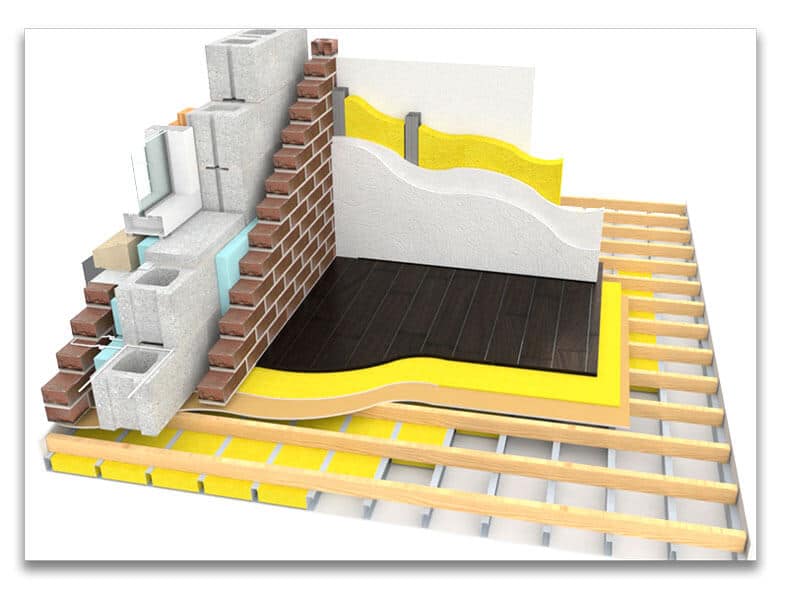
Several sound insulation solutions
Sound insulation of walls:
A quick and design solution is to install heavy curtains against the walls where possible. However the installation of a wall remains the most efficient solution. As I have written above, it is better to use the heaviest possible materials, plaster plate, cinder...
It is also possible to glue a lining complex with embedded insulation. A double wall detached from the wall will be most effective. It consists of two independent walls separated by a spacing that will be filled with rock wool or other acoustic insulation.
Sound insulation by the soil:
Carpeting can reduce noise by 15 to 30 dB. If you don’t like carpet, there are insulating underlayments for floating parquet that are very effective.
The most efficient solution is to pour a concrete or mortar screed on an insulating material. Coupled with ceiling insulation, this solution can reduce the volume of a room by 30 to 40 dBIsolate external noises:
To fight against external noises, it is better to isolate the facade from the outside. Insulation of 30 to 35 dB will eliminate most of the nuisances. Windows and doors are the first ones to focus on.
Air seals must be done perfectly because where the air passes, the noise passes. The "air bridges" should therefore be blocked if necessary. In addition, by equipping yourself with asymmetrical double glazing windows, you will divide by 2 the sound level compared to a standard double glazing.
For very noisy environments (close to an airport), you can opt for double glazing with an "acoustic sheet" and add a second single-pane window. In this case, a reduction of 40 dB will be achieved.
As a general rule, avoid entry-level materials. They are rarely effective and it is important to take care of the implementation of sound insulation processes, at the risk of them not being efficient.
The idea is to decouple the walls, ceilings, and floors as much as possible to prevent the building itself from transmitting noise.
For this, resilient layers of materials are the best allies. If necessary, it will be necessary to call on an acoustic expert in building acoustics, who will be able to make a diagnosis and make a complete report on the possible solutions.
If you buy off-plan:
You should make sure that your manufacturer is aware of acoustic comfort and that it will comply with the standards in force and therefore your sleep. The simplest way is to ask that the acoustic performance be written on the bill of sale and that an acoustic report be made afterwards, in order to be sure of it.
Finally, the simplest thing to do is not to walk around in shoes in your apartment and place felt tips under chairs and furniture.